Transfotech Team
 Becoming a DevSecOps engineer means combining three skill sets into one practical discipline: IT fundamentals, software delivery, and applied security. The realistic path runs through five stages: Linux, networking, and cloud basics; learning to ship code through CI/CD (continuous integration/continuous delivery) pipelines; AWS cloud fundamentals and identity management; security tooling layered into that pipeline; and finally, portfolio projects and real or simulated work experience that prove you can do the job, not just describe it.
New York’s dense concentration of finance, media, and enterprise-technology employers creates strong local demand for this skill set, and a sample of current New York job postings (reviewed below) reflects that. But no single course, bootcamp, or certification guarantees employment. Reaching job-ready status takes deliberate, hands-on practice over months, and even a strong portfolio is one part of a job search that also depends on networking, interview preparation, and timing.
This guide covers what DevSecOps actually means, a step-by-step roadmap for beginners and career changers in New York, the tools and certifications worth knowing, and how to evaluate training options, including where a structured program like Transfotech Academy’s DevSecOps Mastery Program fits into that decision.
What Is DevSecOps?
DevSecOps stands for Development, Security, and Operations. It builds on DevOps (the practice of unifying software development and IT operations so teams can ship code faster and more reliably) by integrating security checks directly into that delivery process, instead of reviewing security only at the very end.
Here’s a simple example. In a traditional workflow, a security team might review an application for vulnerabilities only after it’s fully built, right before release, a manual review that can take days or weeks and often surfaces problems too late to fix cheaply. In a DevSecOps pipeline, that same application passes through automated checks at every stage: a static application security testing (SAST) tool scans source code the moment a developer commits it; a software composition analysis (SCA) tool checks open-source dependencies for known vulnerabilities before the build finishes; and a container image scanner checks for operating-system-level flaws before deployment. If any check fails, the pipeline stops automatically and flags the issue to the developer while the code is still fresh in their mind, not weeks later, after the context is gone.
DevOps vs. DevSecOps
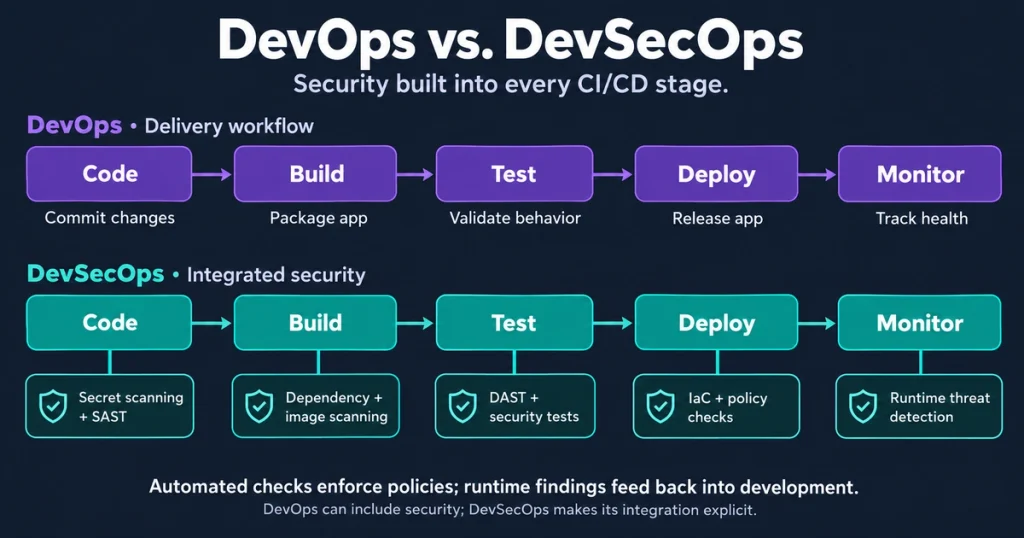
DevSecOps isn’t a replacement for DevOps, and it doesn’t imply that DevOps teams ignore security. Rather, it makes security ownership explicit and automated instead of leaving it as an informal or after-the-fact responsibility.
Benefits of DevSecOps
Moving security earlier and automating it produces several concrete advantages over a bolt-on review process:
Earlier vulnerability detection. Catching a flawed dependency or an insecure code pattern at commit time is dramatically cheaper to fix than catching it in production, where a fix requires an emergency patch, a new release cycle, and possibly incident response.
Faster feedback loops. Developers get an automated pass/fail signal within minutes of pushing code, rather than waiting for a scheduled manual review days later.
Consistent checks. Automated scanning applies the same rules to every commit, every time, removing the variability of manual review, which depends on which reviewer is available and how much time they have.
Better collaboration. When security requirements are visible in the pipeline itself (not in a separate document), developers, operations, and security engineers work from the same source of truth instead of handing work back and forth.
Auditability. Automated pipelines produce a built-in record of every scan, approval, and deployment, useful for compliance reporting and post-incident review, without a separate manual audit trail.
These benefits come from process design, not from a specific tool vendor’s marketing claims, and they compound the earlier they’re adopted in a project’s life.
How to Become a DevSecOps Engineer in New York
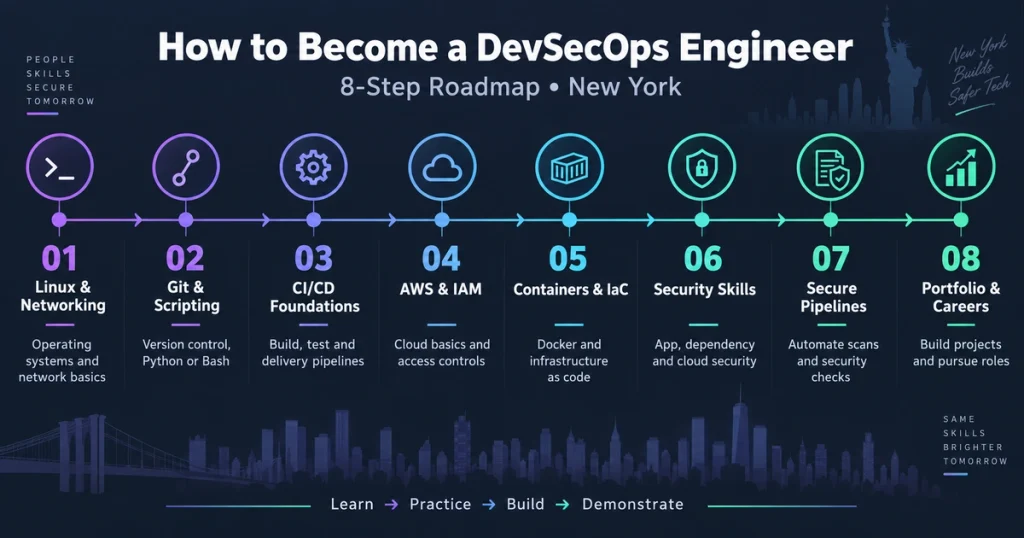
There’s no single certified path into this role, but the following sequence reflects how most working DevSecOps engineers describe their own progression, and how the roadmap-style guides reviewed for this article (roadmap.sh and Practical DevSecOps among them) structure the skill-building process. Steps 1 through 4 are essential beginner ground; steps 5 through 8 build on that foundation and can take longer to master.
1. Linux, networking, and operating-system fundamentals. Nearly every server, container, and cloud instance you’ll touch runs Linux. Learn the command line, file permissions, process management, and basic networking concepts (DNS, HTTP/HTTPS, TCP/IP). Milestone: comfortably navigate and troubleshoot a Linux server without a GUI.
2. Git and basic Python or Bash scripting. Version control (Git) is how teams track and review every change to code and infrastructure. Scripting lets you automate repetitive tasks instead of doing them by hand. Milestone: write a script that automates a real task, such as parsing a log file or renaming a batch of files, and manage it through a Git repository with branches and pull requests.
3. Software development and CI/CD fundamentals. Understand the software development life cycle (SDLC) and how CI/CD pipelines automate building, testing, and deploying code. Milestone: build a simple pipeline (in GitHub Actions, GitLab CI, or Jenkins) that automatically tests and deploys a small application on every commit.
4. AWS cloud foundations and identity management. Learn core AWS services (compute, storage, networking) and, critically, Identity and Access Management (IAM), the system that controls who and what can access cloud resources. Milestone: deploy a small application to AWS using least-privilege IAM roles instead of broad admin permissions.
5. Containers, infrastructure as code, and orchestration concepts. Learn Docker for packaging applications and a tool like Terraform for defining infrastructure as code, plus foundational Kubernetes concepts for container orchestration. Milestone: deploy a containerized application to a cloud environment using infrastructure defined entirely in code, not manual console clicks.
6. Application, dependency, infrastructure, and cloud security. This is where DevSecOps-specific knowledge begins: secure coding practices, dependency vulnerability scanning, infrastructure security scanning, and cloud security posture concepts. Milestone: run a vulnerability scan against your own project and remediate at least one real finding.
7. Integrating security checks into pipelines. Combine steps 3 and 6: add automated security gates (SAST, SCA, container scanning, secrets detection) directly into a CI/CD pipeline so builds fail on serious findings. Milestone: a pipeline that blocks a deployment when it detects a hardcoded secret or a critical vulnerability.
8. Building a portfolio and pursuing suitable roles. Document your projects publicly (GitHub, a personal site, or a LinkedIn portfolio), and target realistic entry points, junior DevOps or DevSecOps roles, or adjacent roles like cloud support or security analyst, rather than senior positions on day one. Milestone: three documented projects (see the hands-on section below) that a hiring manager can review without you present.
Essential Skills and Tools
Beginners don’t need to master every tool in this list. Most working engineers use a subset that matches their team’s stack. It helps to understand each category’s purpose before specializing.
Version control: Git, hosted on GitHub or GitLab, for tracking every change to code and infrastructure.
CI/CD: GitHub Actions, GitLab CI, and Jenkins are the most widely used pipeline tools for automating build, test, and deploy steps.
Infrastructure as code: Terraform (cloud-agnostic) and AWS CloudFormation (AWS-native) let you define infrastructure in version-controlled files instead of manual configuration.
Containers and orchestration: Docker for packaging applications, and Kubernetes (often with Helm for managing configurations) for running containers at scale.
Security scanning: SAST and dependency-scanning tools such as Snyk, and infrastructure-as-code scanners such as Checkov, catch vulnerabilities before deployment; container-focused scanners like Trivy check image contents specifically.
Secrets management: Tools like HashiCorp Vault store credentials and API keys outside of code, so secrets never end up hardcoded in a repository.
Monitoring and observability: Prometheus and Grafana for metrics and dashboards, and the ELK stack (Elasticsearch, Logstash, Kibana) for log aggregation, give teams visibility into how systems behave in production and help detect security anomalies.
Hands-on Learning for an AWS DevSecOps Engineer Course
Reading about these tools only goes so far. Hiring managers reviewing entry-level candidates want evidence of applied work. Three projects, done well, cover most of the ground employers expect:
Project 1: A CI/CD pipeline with dependency, secret, and code scanning.
Objective: demonstrate that you can automate security checks inside a working delivery pipeline.
Example tools: GitHub Actions or GitLab CI, Snyk or an equivalent SCA scanner, a secrets-detection tool, and a SAST scanner.
Deliverable: a public repository where every pull request automatically triggers dependency, secret, and static-code scans, with the pipeline configured to block merges on critical findings.
Portfolio evidence: the pipeline configuration file itself, a screenshot or recording of a blocked build, and a short write-up explaining what the scans catch and why the gate matters.
Project 2: An AWS infrastructure deployment using infrastructure as code and security checks.
Objective: show you can provision cloud infrastructure securely and repeatably, not through manual console clicks.
Example tools: Terraform or AWS CloudFormation, plus Checkov to scan the IaC templates for misconfigurations before deployment.
Deliverable: a version-controlled Terraform (or CloudFormation) project that deploys a small, functioning AWS environment (for example, a web application behind a load balancer) with IAM roles scoped to least privilege.
Portfolio evidence: the IaC repository, the Checkov scan output showing issues found and fixed, and architecture documentation.
Project 3: A container delivery workflow with image scanning, access controls, and monitoring.
Objective: demonstrate secure container practices from build through runtime.
Example tools: Docker, Trivy for image scanning, Kubernetes (a local cluster via minikube or a managed service) for orchestration, and Prometheus/Grafana for monitoring.
Deliverable: a containerized application deployed to Kubernetes, with an image-scanning step before deployment and a basic monitoring dashboard tracking application health.
Portfolio evidence: the Dockerfile and Kubernetes manifests, scan reports, and a dashboard screenshot.
For all three, use free or low-cost sandbox environments rather than a full production AWS account: AWS Free Tier, a personal AWS account with billing alerts configured, or a local Kubernetes cluster (minikube, kind) for the container project. Set a hard budget alert before starting cloud work. Misconfigured resources (an oversized instance left running, for example) are the most common way beginners rack up unexpected charges.
DevSecOps Certifications: What Beginners Should Know
There is no official AWS certification named “AWS DevSecOps Engineer.” That phrase describes a job function, not a specific credential. Below are the verified, currently available certifications most relevant to a beginner’s path, distinguishing foundation-level learning credentials from professional-level, experience-based exams.
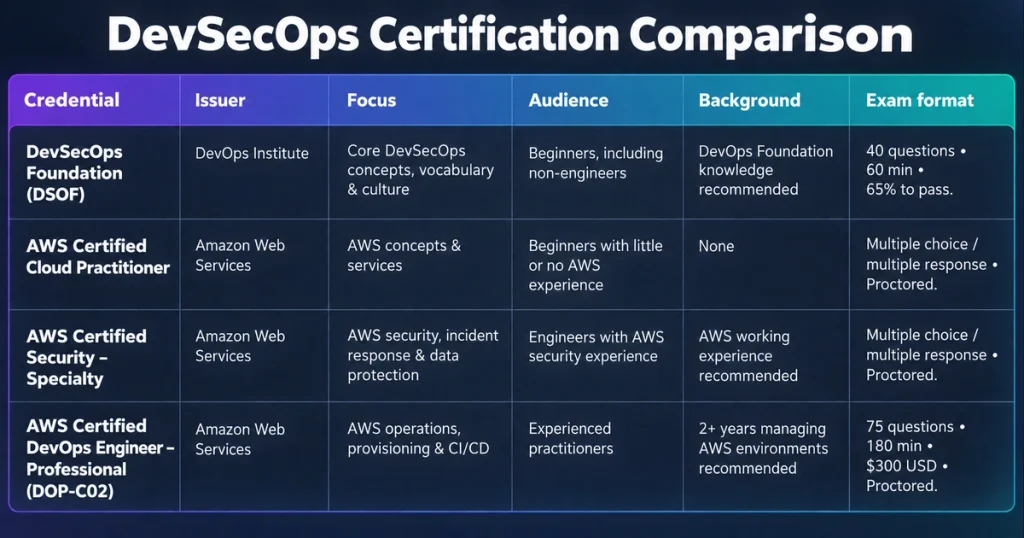
For beginners, DevSecOps training generally splits into two categories that are easy to conflate: structured online course completion (like a bootcamp module or a video-based course, which typically issues a certificate of completion rather than an independently graded credential) and independently assessed certification (like DSOF or an AWS exam, which requires passing a proctored test administered by a third party). Both have value: course completion demonstrates you worked through structured material, while an independent certification demonstrates you can pass an assessment under exam conditions. But they aren’t interchangeable, and job postings that ask for “AWS certification” are almost always referring to the latter.
On the AWS path specifically: AWS Certified Cloud Practitioner is a reasonable starting point for someone new to cloud computing. AWS Certified DevOps Engineer Professional, despite including “DevOps” in its name, is explicitly a professional-level credential. AWS’s own guidance recommends two or more years of hands-on AWS experience before attempting it, so it’s a milestone to work toward after building foundational skills and experience, not a first step.
How to Choose the Best DevSecOps Courses for Beginners
With training options ranging from free YouTube series to multi-thousand-dollar bootcamps, a few evaluation criteria separate genuinely useful programs from ones that look impressive but don’t build job-ready skills:
Prerequisites and structured foundations. Does the course state what background you need, and does it actually build fundamentals before jumping into advanced topics, or assume prior knowledge it never explains?
Practical labs, not just video lectures. Look for hands-on labs using real tools (cloud environments, CI/CD pipelines, scanning tools) rather than slide-based theory alone.
Instructor access and feedback. Live instruction or mentorship where you can ask questions and get feedback on your actual work tends to accelerate learning far more than self-paced video alone.
Real projects with documented outcomes. A course should leave you with artifacts, pipelines, infrastructure code, security configurations, you can show a hiring manager, not just a certificate of completion.
Curriculum currency. DevSecOps tooling changes quickly; a curriculum last updated several years ago may be missing current practices around, for example, AI-assisted code review or newer policy-as-code frameworks.
Transparent scheduling and cost. Clear information on time commitment, live versus self-paced format, and full pricing (including any enrollment deadlines or fees) before you commit.
Realistic career support. Resume help and interview preparation are useful; guarantees of employment or inflated placement claims without methodology are a red flag.
Transfotech Academy’s DevSecOps Mastery Program illustrates how these criteria apply to one specific option. Based on its published course page, it’s a 16-week, live, instructor-led online program (roughly 10 to 15 hours per week, with recorded sessions for anyone who misses a live class), structured around nine phases that move from foundational DevSecOps concepts through cloud infrastructure, CI/CD pipeline engineering, containers, application and runtime security, observability, and a capstone project. The tech stack covered on the course page includes Git, Jenkins, GitLab CI, Terraform, AWS, Docker, Kubernetes, SonarQube, Snyk, Trivy, and Prometheus/Grafana, among others, directly aligned with the tool categories discussed above. It states no prior DevOps or Kubernetes experience is required, includes one-on-one mentorship, and centers its hands-on work around a single simulated payments-API project (“PayCore“) that graduates can point to as portfolio evidence. The program also lists resume support, interview preparation, and recruiter assistance as part of its career-support offering. Prospective students should review current pricing, enrollment deadlines, and payment plan terms directly on the course page, since those details change over time.
If you’d rather build the same foundation through free or lower-cost resources first, that’s a reasonable path too. The roadmap above works whether you’re self-teaching, taking a structured course, or combining both. Explore the DevSecOps course curriculum directly if you want to see how a structured program sequences these topics before deciding.
DevSecOps Career Opportunities in New York
New York’s job market includes several related roles that beginners often confuse: DevSecOps Engineer (security-integrated pipeline and infrastructure work), DevOps Engineer with security responsibilities (a DevOps role where security is one part of a broader mandate rather than the primary focus), Cloud Security Engineer (security-focused, with less emphasis on pipeline automation), and Application Security Engineer (focused on securing application code specifically, often with less infrastructure work).
Experienced-level postings in these categories in New York tend to sit with finance, fintech, and large enterprise-tech employers: a live sample pulled from Glassdoor during this research showed 188 open listings tagged “DevSecOps engineer” in New York, NY, with employers spanning fintech (Kalshi, Polymarket), enterprise tech (Palantir), and large media/entertainment companies (Disney), commonly requiring CI/CD pipeline experience, Terraform, and AWS.
That sample skewed toward senior and staff-level compensation bands and should be read as evidence of active hiring demand and required tooling, not as a representative entry-level salary figure. A broader labor-market study would be needed for that.
For someone starting out, the realistic entry point usually isn’t a “DevSecOps Engineer” title directly. Stepping-stone roles, junior DevOps engineer, cloud support engineer, or security analyst, let you build the CI/CD, cloud, and security experience that DevSecOps roles expect, using transferable skills like scripting, Linux administration, and cloud fundamentals that apply across all of them. Career-guide sources reviewed for this article (including Practical DevSecOps’ own 2026 analysis, which cites a national average of roughly $137,495 for the DevSecOps engineer title, and other guides citing lower national averages around $101,700) show wide variation depending on methodology and seniority mix. Treat any single figure as directional rather than a guarantee of what a specific New York role will pay.
DevSecOps Training FAQs
1. What are the main objectives of DevSecOps training?
To build practical skills across development, operations, and security, specifically, the ability to build and secure CI/CD pipelines, manage cloud infrastructure safely, and integrate automated security checks into the software delivery process.
2. What are the prerequisites?
Most beginner-friendly training assumes little to no prior experience, though basic computer literacy helps. Programs vary. Some, like DevSecOps Foundation, recommend familiarity with DevOps concepts first; others start from zero.
3. Who should join?
IT professionals, developers, and system administrators looking to add security and automation skills; career changers with some technical aptitude; and cybersecurity learners who want to add development and operations context to their security knowledge.
4. Why should I learn DevSecOps?
It combines three in-demand skill areas into one role, and organizations increasingly expect security to be integrated into delivery pipelines rather than handled separately, which creates ongoing demand for people who can do both.
5. What essential skills are covered?
Linux and networking fundamentals, Git and scripting, CI/CD pipeline design, cloud fundamentals (commonly AWS), infrastructure as code, containers and orchestration, and security practices including vulnerability scanning, secrets management, and policy-as-code.
6. Which jobs can this training help me work toward?
Junior DevOps Engineer, DevSecOps Engineer, Cloud Security Engineer, Application Security Engineer, and related roles, depending on how the training is structured and how much hands-on project work you complete.
7. Can beginners learn DevSecOps without prior coding experience?
Yes, though basic scripting (Bash or Python) is typically introduced early, since most DevSecOps work involves automating tasks rather than deep software engineering. A structured program should teach this rather than assume it.
8. Can I complete DevSecOps training online from New York?
Yes. Many programs, including Transfotech Academy’s DevSecOps Mastery Program, are delivered fully online with live instruction, which means location within New York (or anywhere else) doesn’t limit access to the training itself.
9. Is AWS Certified DevOps Engineer – Professional suitable for beginners?
Not as a starting point. AWS’s own guidance recommends two or more years of hands-on AWS experience before attempting it. Beginners are better served starting with AWS Certified Cloud Practitioner or a foundation-level credential like DevSecOps Foundation, then working toward the professional-level exam later.
10. How long does it take to become a DevSecOps engineer?
There’s no fixed timeline, and no training program can promise one. Career-guide estimates commonly cited elsewhere range from several months (for someone with an existing IT or development background) to a few years (for someone starting with no technical background), depending on prior experience, time invested, and how quickly you build a credible portfolio.
Next Step
The roadmap above works whether you build it yourself from free resources or follow a structured program. What matters is consistent, hands-on practice across the CI/CD, cloud, and security skills covered here. If you want that sequence taught in a structured, mentored format, Transfotech Academy’s DevSecOps Mastery Program is one option built around this exact progression.