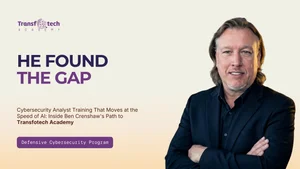
Ben Crenshaw
For years, a persistent myth has kept curious minds and analytical thinkers locked out of the cybersecurity and intelligence industries. The myth goes like this: If you cannot write complex Python scripts, reverse-engineer malware, or configure corporate firewalls, you cannot work in cyber defense.
As an industry professional, cybersecurity educator, and Lead Instructor and Program Developer at Transfotech Academy, I am here to tell you that this assumption is completely wrong.
While technical engineers work hard to secure hardware and networks, a massive portion of modern security relies on a completely different discipline: Open Source Intelligence (OSINT). OSINT is the art and science of gathering, analyzing, and synthesizing publicly available information to protect organizations, investigate threats, and inform strategic decisions.
If you are naturally curious, love solving puzzles, pay close attention to detail, and enjoy research, you already possess the core DNA required for a high-paying, high-growth career in OSINT, no coding or computer science degree required. This should make you feel capable and motivated to start your journey.
What Is OSINT? (The Power of Public Data)
Open Source Intelligence (OSINT) refers to any intelligence produced from publicly accessible data. This includes information found across:
- The Surface Web: News articles, corporate registries, domain registration records, public property filings, and personal blogs.
- Social Media & Online Communities (SOCMINT): Public profiles, forums, geotagged photos, and online discussions.
- Deep & Dark Web Repositories: Leaked database dumps, paste sites, and threat actor forums.Real-World Examples: How OSINT Protects Businesses
OSINT is not about hacking into private servers; it is about finding the digital breadcrumbs people and organizations leave behind every day.
- Corporate Brand & Asset Protection: Detecting a fake e-commerce website or spoofed social media account using a company’s logo and domain name to scam customers before damage occurs.
- Geopolitical Threat & Executive Safety: Monitoring open news feeds, flight trackers, and local social media posts to ensure corporate employees or assets traveling abroad remain safe during sudden political instability.
- Supply Chain & Vendor Vetting: Investigating public financial registries, court records, and domain histories of third-party vendors to ensure they are legitimate before a major contract is signed.
High-Demand OSINT & Intelligence Roles
If you enter the job market through an OSINT pathway, you can target several dynamic, non-technical roles:
1. Open Source Intelligence (OSINT) Analyst
- The Role: You act as a digital detective. You gather, analyze, and synthesize publicly available data to identify corporate threats, track threat actor tactics, or investigate internal/external corporate fraud.
- Why as a Threat Intelligence Researcher? It relies on structured research frameworks, critical thinking, and search methodologies rather than programming, making it accessible to beginners.
2. Threat Intelligence Researcher
- The Role: You monitor public threat feeds, paste sites, and dark web forums to track emerging cyber threats, profile cybercriminal groups, and produce actionable intelligence briefs for executive leadership.
- Why It’s Beginner-Friendly: It focuses on pattern recognition, synthesizing complex information, and clear written communication.
3. Digital Footprint & Brand Protection Specialist
- The Role: You scan the internet to detect unauthorized use of corporate trademarks, brand impersonation, fraudulent domains, and accidentally exposed corporate documents or credentials.
- Why It’s Beginner-Friendly: You utilize specialized search operators, online monitoring platforms, and visual comparison rather than technical systems engineering.
4. OSINT Content Writer & Educator
- The Role: You create clear OSINT investigation playbooks, research reports, intelligence summaries, and training guides for internal security teams or clients.
- Why It’s Beginner-Friendly: It leverages traditional writing, editing, and analytical skills to make complex digital investigations easy for non-technical stakeholders to understand.
Key Transferable Skills You Already Have
If you come from backgrounds like journalism, research, law, criminal justice, customer service, business administration, or teaching, you likely already possess the most critical skills needed for OSINT:
- Curiosity & Investigative Drive: The passion to dig deep into data breadcrumbs and connect seemingly unrelated pieces of information until a clear picture emerges.
- Attention to Detail: The discipline to verify sources, cross-check facts, and spot disinformation, deepfakes, or spoofed profiles.
- Clear Communication: The ability to translate complex digital findings and intelligence summaries into plain, actionable language for business decision-makers.
Training, Certifications, and Bridging the Gap
To break into OSINT, employers do not look for advanced degrees in computer science. Instead, they look for credentials and practical proof demonstrating that you understand research methodologies, data privacy laws, and structured intelligence frameworks.
Top Entry-Level Certifications & Pathways
- General Foundations:
- CompTIA Security+: Establishes a baseline security vocabulary and introduces how threats operate across the enterprise.
- ISC2 Certified in Cybersecurity (CC): Ideal for complete beginners focusing on core security concepts and access principles.
- OSINT & Intelligence Specifics:
- Foundational OSINT research methodology courses.
- Core digital forensics concepts (understanding digital evidence and metadata).
- Social Media Intelligence (SOCMINT) framework training.
- Career-Changer Training:
- Google Cybersecurity Professional Certificate: Provides a broad operational foundation in security tools and documentation.
- Specialized open-source research certificates focused on digital footprint tracking and human-risk analysis.
How Transfotech Academy Prepares You: Self-study is great for learning search techniques, but gaining the confidence to land a job requires real-world application. Our practical, hands-on approach aims to give you confidence that you can succeed in the field.
Self-study is great for learning search techniques, but gaining the confidence to land a job requires real-world application.
At Transfotech Academy, our Cybersecurity and OSINT Programs are designed to transform career changers with no prior knowledge into job-ready professionals by emphasizing practical skills and real-world applications to boost confidence and employability, and by focusing on Outcome-Based Education (OBE).
Instead of just reading theory, our students engage in real-world intelligence workflows:
- Conducting structured open-source investigations.
- Mapping threat actor techniques.
- Tracking digital footprints and brand exposure.
- Compiling professional intelligence reports that can be showcased directly to hiring managers.
Final Thoughts: The World Is Built on Information
You do not need to learn how to code to build a successful, high-paying career in cyber defense. Modern intelligence work is driven by critical thinking, analytical rigor, and creative research.
If you’re ready to turn your natural curiosity into a high-demand career as a digital investigator, explore our programs at Transfotech Academy and start your journey today.