Transfotech Team
The best software testing certifications in 2026 are the ISTQB Certified Tester Foundation Level (CTFL) for beginners, ISTQB Test Automation Engineer for career growth, and the new ISTQB AI Testing (CT-AI) for future-proofing your skills. The ISTQB Foundation exam costs $229 in the USA but a certification alone won’t get you hired. Employers in New York, and across the US, Canada, and the UK, want proven hands-on skills to go with it.
That gap between “certified” and “hireable” is exactly what this guide covers. Here’s what each certification costs, which ones are actually in demand, where to find free software testing courses online, and how to land a QA job in the United States even with no experience.
What Is Software Testing (and Why Does It Matter)?
Software testing is the process of evaluating an application to find defects and verify it behaves as intended before it reaches users. Every app on your phone, every checkout page, every banking portal was tested — or should have been.
Why is software testing important? Because failure is expensive. A single bug in production can cost 10–100x more to fix than one caught during development. That’s why the U.S. Bureau of Labor Statistics projects employment for software developers, QA analysts, and testers to grow 15% from 2024 to 2034 — much faster than the average occupation — with roughly 129,200 openings per year. QA analysts and testers alone held about 201,700 US jobs in 2024.
The history of software testing stretches back to the 1950s, when debugging and testing were considered the same activity. Testing became a distinct discipline in the 1980s, matured through the agile era of the 2000s, and is now entering its biggest shift yet: AI-assisted and AI-powered testing.
QA vs. Software Testing: What’s the Difference?
People use the terms interchangeably, but they’re not identical. Quality assurance (QA) is process-oriented — it focuses on preventing defects by improving how software is built. Software testing is product-oriented — it finds defects in the software itself. In practice, most “QA Engineer” roles in the US job market involve both, plus test automation.
The Benefits of Software Testing
The benefits of software testing show up directly on the balance sheet, which is why companies keep hiring testers:
- Lower defect costs — bugs caught in development cost 10–100x less than bugs found in production
- Protected revenue and brand trust — a broken checkout or login page loses customers instantly
- Faster, safer releases — automated regression suites let teams ship weekly without breaking existing features
- Security and compliance — testing catches vulnerabilities before attackers or regulators do
- Better user experience — quality software retains users; buggy software drives them to competitors
The Main Types of Software Testing
Before choosing a certification, understand what you’ll actually be certified in.
Manual testing — A human tester executes test cases without automation tools: exploring the app, following test scripts, and reporting bugs. It’s the standard entry point for beginners and still essential for usability and exploratory testing.
Automated testing — Test scripts (using tools like Selenium, Playwright, or Cypress) execute checks automatically. Automation skills are the single biggest salary lever in QA: job postings increasingly list automation as a requirement, not a bonus.
Regression testing — Re-running existing tests after every code change to make sure new updates didn’t break old functionality. In agile teams shipping weekly (or daily), regression testing is where automation delivers the most ROI — which is why it dominates automation job requirements.
Manual vs. Automated Testing: Which Should You Learn First?
Learn manual testing fundamentals first — test design, defect reporting, SDLC — then layer automation on top. Employers in New York and other major US tech hubs rarely hire “manual-only” testers anymore; the market standard in 2026 is a hybrid QA engineer who can do both, increasingly with AI tools accelerating the work.
Software Testing Certifications in Demand in the USA (2026 List)
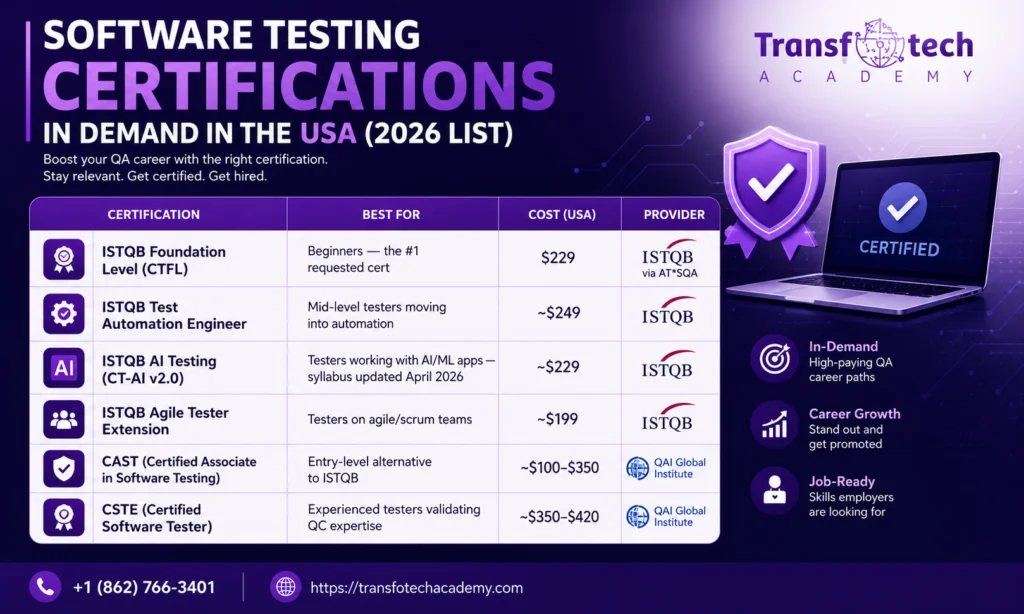
Here’s the testing certification list that actually appears in US job descriptions, with current costs:
| Certification | Best for | Cost (USA) | Provider |
|---|---|---|---|
| ISTQB Foundation Level (CTFL) | Beginners — the #1 requested cert | $229 | ISTQB via AT*SQA |
| ISTQB Test Automation Engineer | Mid-level testers moving into automation | ~$249 | ISTQB |
| ISTQB AI Testing (CT-AI v2.0) | Testers working with AI/ML apps — syllabus updated April 2026 | ~$229 | ISTQB |
| ISTQB Agile Tester Extension | Testers on agile/scrum teams | ~$199 | ISTQB |
| CAST (Certified Associate in Software Testing) | Entry-level alternative to ISTQB | ~$100–$350 | QAI Global Institute |
| CSTE (Certified Software Tester) | Experienced testers validating QC expertise | ~$350–$420 | QAI Global Institute |
Which Certification Is Best for Software Testing?
For 90%+ of career changers in the USA, the best software testing certification for beginners is the ISTQB Foundation Level (CTFL). It’s globally recognized in 130+ countries, it’s the prerequisite for every advanced ISTQB track, and at $229 through AT*SQA (the official US exam provider) it’s the best cost-to-recognition ratio in the industry. The certified software tester (CSTE) credential from QAI carries weight for experienced QC professionals but requires prior education/experience, making it a poor first certification.
The fastest-growing credential to watch: ISTQB AI Testing. With AI features now embedded in most commercial software, testers who can validate AI-driven systems are commanding premium salaries — and very few candidates hold this cert yet. Low supply, rising demand.
ISTQB Certification Cost: The Full Math
The ISTQB certification cost in the US is $229 for the Foundation Level exam (40 multiple-choice questions, 60 minutes, 65% to pass). Your voucher stays valid for 365 days — and like most software testing certification online exams, it can be taken remotely with online proctoring from anywhere in the US or worldwide. Budget realistically, though: self-study materials are free (the official syllabus is public), but structured software testing course fees range from $300 for basic exam-prep courses to $3,000–$15,000 for full QA bootcamps with job placement support. The difference isn’t the certificate — it’s whether you graduate with portfolio projects and interview pipelines.
Best Free Software Testing Certifications and Courses
Can you start for $0? Yes. If you’re looking for the best software testing certifications free of charge, these are the top software testing course online free options:
- ISTQB official syllabus and sample exams — free downloads; everything you need to self-study for CTFL
- Test Automation University (Applitools) — free, respected automation courses with completion certificates
- freeCodeCamp QA and testing tutorials — free, project-based
- Coursera/edX audit tracks — free to learn (you pay only if you want the certificate)
Honest trade-off: free software testing certification options prove motivation, but they carry little weight with US recruiters on their own. Use them to confirm you enjoy the work — then invest in the recognized credential (ISTQB) plus hands-on training. Recruiters screen for demonstrable skills: real test plans, automation frameworks on GitHub, and bug reports — things free video courses don’t give you.
No Experience Software Testing Jobs in the United States: How to Break In
Searching “no experience software testing jobs in United States” returns thousands of listings — but landing one takes strategy. We wrote a full guide on this: how to get software testing jobs in the USA with no experience. Here’s what the data says:
The market is strong, especially in New York. The average software QA tester salary in New York, NY is $82,000–$95,000 per year — roughly 27% above the national average — with entry-level QA roles typically starting at $55,000–$72,000. Fintech, healthcare, and media companies in NYC hire QA engineers continuously, and remote roles open the entire US market. Demand is similarly strong in tech hubs across Canada (Toronto), the UK (London), Germany, Australia, and the Gulf region — QA skills are globally portable, and ISTQB is recognized in all of these markets.
What gets a no-experience candidate hired (in order of impact):
- Hands-on projects — a portfolio with real test cases, bug reports, and at least one automation framework
- One recognized certification — ISTQB CTFL clears the HR screening filter
- Automation + AI tool exposure — Selenium, API testing (Postman), and AI-assisted testing tools
- Interview preparation and referrals — most entry QA roles in NYC are filled through staffing agencies and referrals, not cold applications
Notice that certification is only one of four pillars. This is where most self-taught candidates get stuck — and where structured programs earn their fees.
The Fastest Path: Certification + AI Skills + Job Placement in One Program
The best software testing course online isn’t the cheapest one — it’s the one that bundles training, certification prep, and job placement. If you want the complete stack — manual testing, automation, AI-powered testing tools, and active job placement — that’s exactly what the AI-Powered QA Engineering Program at Transfotech Academy delivers.
It’s a mentor-led, live online program (attend from our Manhattan campus at 132 W 31st St, New York, or join remotely from anywhere in the US, Canada, or worldwide) that takes you from zero to job-ready QA engineer in 6 months:
- Manual + automated testing — from testing fundamentals through Playwright, Selenium, API testing, and CI/CD with Jenkins, GitHub Actions and Jira
- AI-powered test frameworks — the skill set that separates 2026 candidates from 2020 resumes
- Real portfolio projects — including an end-to-end automation suite and API validation packs
- A 1-month in-house internship with real QA project work before job placement begins
- Active placement support until you’re hired — your profile marketed to 100+ hiring partners, with graduates landing roles in the $88K–$153K range
No tech background required — 3,000+ students trained since 2012, including career changers now working at companies like IBM, Accenture and Deloitte.
Book a free career session to map your personal path from beginner to certified, employed QA engineer.
Frequently Asked Questions
Which certification is best for software testing beginners?
The ISTQB Certified Tester Foundation Level (CTFL) is the best software testing certification for beginners. It costs $229 in the USA, requires no prior experience, is recognized in 130+ countries, and is the prerequisite for all advanced ISTQB certifications.
How much does ISTQB certification cost?
The ISTQB Foundation Level exam costs $229 in the United States through AT*SQA, the official exam provider. Advanced-level ISTQB exams typically cost $199–$249. Vouchers remain valid for 365 days from purchase.
Can I get a software testing certification free?
Fully free recognized certifications are rare, but you can study free: the ISTQB syllabus and sample exams are free to download, and Test Automation University offers free automation courses with certificates. You’ll still pay the exam fee for recognized credentials.
Can I get a QA job with no experience in the USA?
Yes. QA is one of the most accessible entry points into US tech, with 15% projected job growth through 2034. Employers hire no-experience candidates who combine a recognized certification (ISTQB), a hands-on project portfolio, and automation skills — which structured training programs are designed to deliver.
Is software testing a good career in New York?
Yes. Software QA testers in New York earn $82,000–$95,000 on average — about 27% above the national average — with entry-level roles starting around $55,000–$72,000. NYC’s fintech, healthcare, and media sectors hire QA engineers year-round.
Ready to start? Explore the AI-Powered QA Engineering Program or book your free career session — live from New York, open to students worldwide.