Ben Crenshaw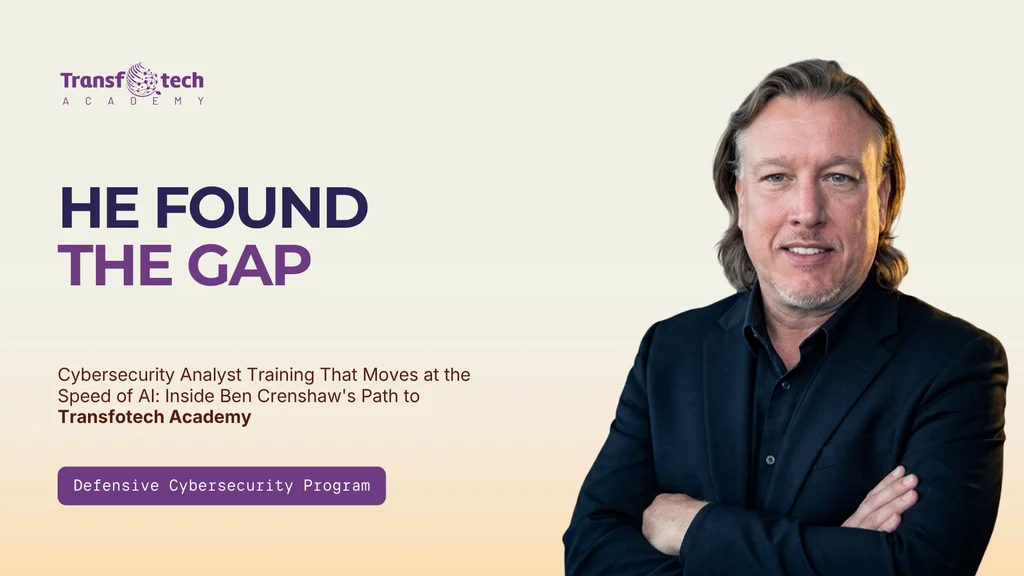
Inside the career change behind Transfotech Academy’s AI-powered cybersecurity training instructor
For eight years, Ben Crenshaw had one job. Find the weak spot before someone else finds it first.
He did this at Oracle. His title was Vulnerability Analyst. In plain terms, he checked networks and software for weak spots, then scored how bad each one was. This work does not get you praise. Nobody claps for the hack that never happens. You just move to the next system and check again.
Then he did something you would not expect.
He walked into a high school classroom. Not as a guest. As the teacher. In Sandy, Utah, he started teaching a full-year cybersecurity class, while he still worked in enterprise security. That is a big change. And most people who make that kind of career change into cybersecurity teaching leave the old job behind first. He did not. You might guess this was him slowing down. Taking it easy. Giving back.
That is not what happened.
Crenshaw did not slow down. He found a new weak spot. This one was not in a firewall. It was in how we train people for the job.
He later wrote a book about it, called Teaching Cyber: Building the Bridge Between Education and Industry. His point is simple: companies spend huge amounts of money trying to fill cybersecurity jobs. At the same time, many teachers stand in front of a class without the tools or training to actually prepare students for those jobs. The system that is supposed to build new talent is broken. And in his view, you fix it by helping teachers first, not by throwing more money at hiring.
So he set out to fix it.
At Work ED, where he was Head of Cyber and AI Education, he did not just teach one classroom. He built tools so other teachers could teach the same way he did. He trained the trainers. Then he took the whole approach national, bringing cybersecurity and AI training to students in New York, California, and Utah.
The results are specific, and they hold up. One program he ran for the NYC Department of Education got a 97% student recommendation rate. That program did not just get praise, it got a permanent spot in the district’s yearly budget. That is a stronger kind of proof than a nice quote. A separate 125-hour program he built at the Brooklyn STEAM Center scored 4.38 out of 5, and it led to mock job interviews with IBM and AWS. And in a program built around AI tools in Manhattan, adult students went from a 79% score to a 96% score in five days.
Five days. Not five months. Five days.
That number backs up something Crenshaw says often: learn once, apply many times. This is not just a catchy line about repeating something. It means real understanding sticks fast once someone explains it in a way you can actually use. You can see the same idea in a side project he runs called The Cyber Sensei, aimed at regular people, not IT teams. His point there is simple too: scammers do not usually hack your computer. They hack your judgment. Same idea, different audience. Cut the fear. Cut the jargon. Show people the real thing. Let them act on it.
That same mindset shows up outside of paid work too. Crenshaw mentors young talent for the U.S. Cyber Games. He also judges TraceLabs’ Search Party CTF, where cybersecurity skills get used to help find missing people. It is the same careful, patient checking he once did at Oracle, just pointed at something with no paycheck attached. In interviews about his teaching, he has also said ethics is not a side lesson. He calls it the real difference between someone who protects systems and someone who attacks them.

Look at his path forward from Oracle, and it does not look like a straight line. Look at it backward, from the problem he kept finding, and it does. He kept spotting skilled people stuck in front of a gap, missing the one tool that would close it. First it was a network. Then a classroom. Then an entire training system for an industry that cannot hire fast enough.
He has kept doing the same job, just at a bigger scale: find the weak spot nobody assigned him to find, then build something people can actually use to fix it.
The clearest example right now is the program he leads at Transfotech Academy: the Cybersecurity Analyst Program, focused on SOC and AI Defense. It is a 24-week cybersecurity analyst training track, built for people making exactly this kind of career change. It runs on the same “learn once, apply many times” idea. Every week pairs a live class with a hands-on lab right after, so nothing sits as theory for long.
Crenshaw still teaches security the same way he always has, using a castle: a strong foundation, guarded gates, a watchtower for keeping watch, and eventually, permission to break in yourself and test what you built. The program lines up with CompTIA Security+ and the NICE Cybersecurity Workforce Framework, the same standards most SOC analyst training gets measured against. And students leave with the same kind of proof his past students left with: a public GitHub page, a final project built against a live simulated attack, and a resume built to actually get past an applicant tracking system on the way to a first cybersecurity job.
That is the pattern worth watching for in future instructor stories too. Not the list of credentials. The specific gap someone noticed on their own, and what they built to close it.
If this is the kind of program you want to build your own career change around, you can see the full Cybersecurity Analyst Program details here.
FAQ
Do you need a computer science degree to become a cybersecurity analyst? No. Crenshaw did not take that path. He learned through hands-on work and certifications. TFT’s cybersecurity analyst training works the same way. It leans on labs and a portfolio, not a college transcript.
Will AI replace cybersecurity jobs? No. But it is changing what skills you need. Companies are adding AI to help spot threats faster, not to remove the people who watch for them. That is why this program teaches AI as a tool analysts use, not something to fear.
Is a cybersecurity bootcamp worth it for a career changer? It depends on the proof it gives you. Crenshaw’s own students walked away with real results: a 97% recommendation rate on one program, mock interviews with IBM and AWS on another, and a jump from 79% to 96% in test scores in just five days on a third. A bootcamp is worth it when it produces results like that, not just a certificate of attendance.
What certifications does cybersecurity analyst training typically prepare you for? Most programs, including this one, build toward CompTIA Security+. It is the certification most employers actually check for when hiring junior SOC analysts and IT security staff.
How long does it take to become job-ready in cybersecurity? This program runs 24 weeks, which is normal for the field. Self-study for certifications alone can take two to four months. A full program with live classes, hands-on labs, and a final project usually takes three to six months.
What can you earn in a cybersecurity job in the US? Pay varies a lot by role and experience. Here are the starting salary ranges for 2026:
| Role | US Salary Range (2026) |
| Junior SOC Analyst | $68,000 – $85,000 |
| Penetration Tester | $90,000 – $160,000 |
| Malware Analyst | $90,000 – $145,000 |
| Threat Intelligence Analyst | $93,000 – $164,000 |
| Offensive Security Engineer | $123,000 – $152,000 |
| Red Team Operator | $120,000 – $220,000 |
| Vulnerability Researcher | $144,000 – $345,000 |
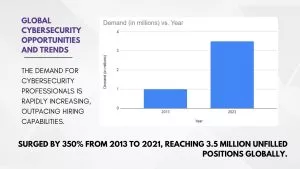
These are entry points into a field with a well-known talent shortage, which is part of why demand for trained analysts keeps climbing.