Transfotech Team
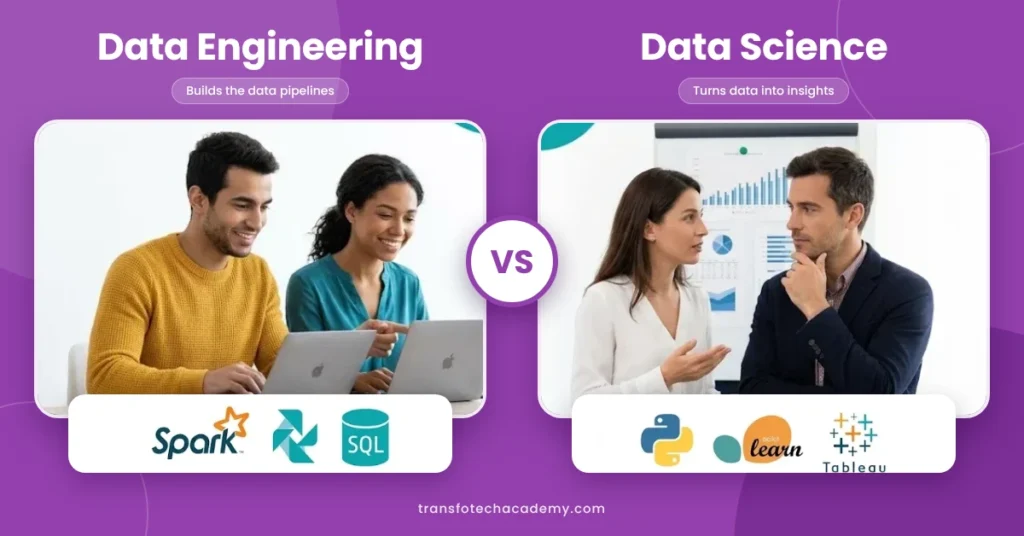
A data engineer builds and maintains the systems that collect, clean, and deliver data. A data scientist uses that data to analyze patterns, run experiments, and build predictive models. Titles overlap, especially at smaller companies, but the core split holds: engineers make data reliable and available, while scientists turn it into decisions.
Data engineer vs. data scientist at a glance
| Data engineer | Data scientist | |
| Main goal | Deliver trustworthy, usable data on schedule | Answer business questions and predict outcomes |
| Daily work | Build and monitor pipelines, model data, fix quality failures | Explore data, test hypotheses, train and evaluate models |
| Common tools | SQL, Python, dbt, Airflow, Spark, cloud warehouses | SQL, Python, pandas, scikit-learn, Jupyter, visualization tools |
| Typical deliverables | Pipelines, data tables, quality checks | Analyses, experiment results, forecasts, models |
| Collaboration | Software engineers, analysts, data scientists | Product, marketing, finance, data engineers |
Tool examples draw partly on Databricks’ comparison; employers vary.
What does a data engineer do?
A data engineer builds the pipelines that move data from source systems into a place where people can use it. A pipeline is an automated sequence of steps: extract data from apps and payment systems, transform it into a consistent format, and load it into a warehouse. Engineers call this ETL.
Quality work matters just as much. Engineers write checks that catch duplicate orders, missing timestamps, and changed column names before bad data reaches a dashboard. When a pipeline fails overnight, the engineer usually gets the alert.
What does a data scientist do?
A data scientist uses statistics and machine learning to find patterns, test ideas, and predict outcomes. The U.S. Bureau of Labor Statistics (BLS) says data scientists “use analytical tools and techniques to extract meaningful insights from data”.
Two activities define the work. Experimentation means designing tests, such as comparing two checkout pages, and judging whether the difference is real. Modeling means training an algorithm to forecast something, such as next month’s demand, then measuring its error honestly. At companies with mature data teams, scientists start from tables that engineers have already cleaned and organized.

One shared project (illustrative example)
This scenario is illustrative, not a real case study.
An online retailer wants fewer stockouts before the holidays.
- Engineer: Builds a daily pipeline that combines orders, inventory counts, and website events into one warehouse. Adds checks for duplicate orders and missing store codes.
- Scientist: Uses that data to forecast demand by product and region, tests the forecast against last year’s holiday weeks, and designs an A/B test for a “low stock” badge.
- Together: The forecast lands in a table the merchandising team reads each morning. If the pipeline delivers late or wrong data, even a strong model produces bad recommendations.
Skills and tools
Both roles start with SQL and Python. SQL retrieves and reshapes data; Python automates work and handles analysis.
Data engineers then add data modeling, workflow orchestration (Airflow), transformation tools (dbt), cloud storage, version control, and testing. Data scientists add probability, statistics, experiment design, machine learning, and the ability to explain uncertain results to non-technical colleagues.
For education, BLS lists a bachelor’s degree in mathematics, statistics, computer science, or a related field as typical for data scientists, and notes some employers prefer a master’s or doctorate (BLS). BLS publishes no equivalent entry for data engineers, so requirements vary by employer.
U.S. data scientist vs data engineer salary and job outlook
BLS does not track data engineers as a separate occupation, so no government figure applies to them directly. That limits every comparison below.
Data scientists (BLS):
The median annual wage was $120,230 in May 2025. BLS projects 35% employment growth from 2025 to 2035, with about 24,800 openings per year (BLS).
A related proxy (BLS):
Database architects, who design and secure data storage systems, had a median wage of $139,500 in May 2025 and projected growth of 9% (BLS). This is a related occupation, not data engineering. Use it as a rough reference only.
Both titles, one source:
Coursera, citing Glassdoor, reported median total pay of about $131,000 for data engineers and $153,000 for data scientists in the U.S., accessed November 18, 2025 (Coursera). Total pay includes bonuses and other pay, and Glassdoor data is self-reported.
These sources measure different things, so do not subtract one figure from another. None shows entry-level pay, and one snapshot does not prove either role always pays more or offers better job security. If you are targeting New York City, compare current local postings for both titles and note which tools employers list.
Which career fits you?
Editorial guidance, not research findings.
Data engineering may fit you if you:
- Like building systems that run without attention
- Enjoy debugging and tracing why something broke
- Prefer concrete “it works or it doesn’t” feedback
Data science may fit you if you:
- Like asking open-ended questions and testing answers
- Are comfortable with statistics and uncertain results
- Enjoy explaining findings to decision-makers
Test it cheaply. Databricks suggests spending two weeks on a pipeline and two weeks on a model to see which you prefer.
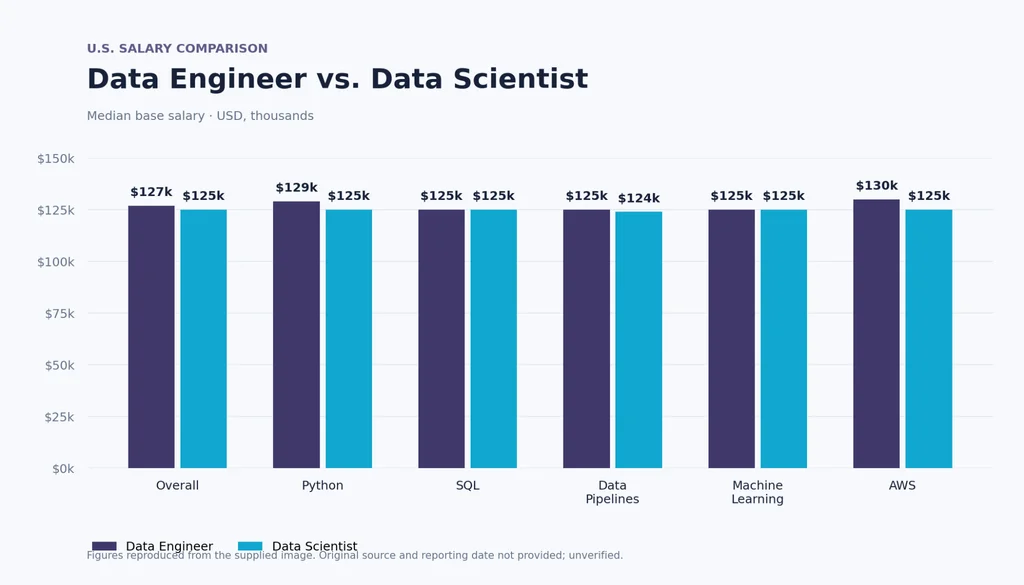
U.S. SALARY COMPARISON Data Engineer vs. Data Scientist
A realistic starting roadmap
Shared foundation: SQL (joins, aggregation, window functions), Python basics, Git, and introductory statistics.
Data engineering path: Learn data modeling, build ETL workflows with dbt, schedule them with an orchestrator, and practice on a cloud warehouse. Portfolio project: Pull NYC Open Data 311 service requests daily, load them into a warehouse, add automated quality tests, and publish a simple dashboard.
Data science path: Learn pandas, regression, classification, forecasting, and model evaluation. Portfolio project: Forecast weekly 311 request volume by borough, compare your model against a simple baseline, and document assumptions and limits.
Frequently Asked Questions (FAQs)
Is data engineering harder than data science?
Neither is universally harder. Engineering demands systems thinking and patient debugging; science demands statistical judgment and comfort with ambiguity. Your strengths decide which feels harder.
Can a data engineer become a data scientist?
Yes. The main gap is usually statistics, modeling, and communication, not programming. Add machine learning coursework and projects built on real datasets. The reverse move works too: scientists must learn orchestration, cloud services, and pipeline reliability.
Which role pays more?
It depends on source, employer, city, and experience. The Glassdoor snapshot above shows a higher median for data scientists, but BLS has no data engineer figure to confirm it. Compare current postings in your target market.
Which role is better for a beginner?
Both are reachable. Start with SQL and Python, then choose based on the work you enjoy. Many teams value scientists who understand pipelines and engineers who understand how models use data.
Should I learn both?
Learn the shared foundation first, then specialize. Knowing both helps you collaborate and keeps options open, but employers usually hire for one focus.
Explore the curriculum
Transfotech Academy’s Data Engineering with Data Science program runs 24 weeks in live, instructor-led sessions: 12 weeks of data engineering, then 12 of data science. It covers Python, pandas, SQL, data modeling, ETL, cloud pipelines, statistics, classification, and forecasting, and ends with a capstone that connects a pipeline to a forecast or model. The first section assumes no prior Python or SQL.
Review the curriculum to see whether the sequence fits your goals. Certificates show course completion and do not guarantee employment or salary.